/7 min read
I opened the pricing pages of six Indonesian digital invitation platforms. The struck-through price never goes away, the invitation itself is free, and what's really being metered is guests, messages and time.
Two weeks ago I counted the buyers in the digital invitation market using official records. This time it’s the sellers’ side, and that side is far easier to check: their pricing pages are open to anyone.
I went through six of them, one by one, on 19 September 2026. Treat this as a snapshot — it will become clear shortly why the word “snapshot” is doing real work here.
The struck-through price never goes away
Invisay lists four packages, and all four are discounted. Silver at Rp55,000 down from Rp110,000, Gold at Rp74,000 from Rp148,000, Platinum at Rp99,000 from Rp198,000, Diamond at Rp129,000 from Rp258,000. A limited-promo countdown runs at the top of the page. I came back a few hours later and the countdown was still running.
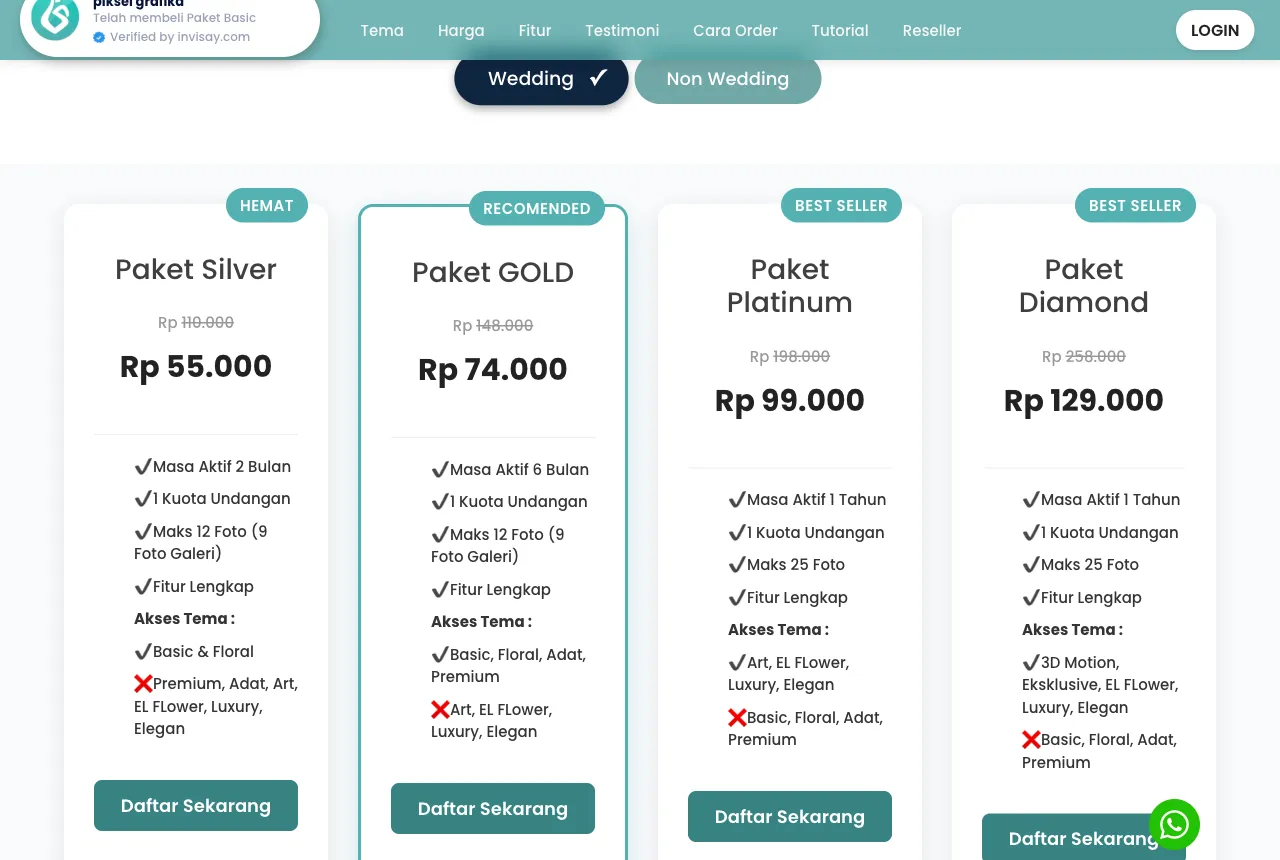
Invisay’s four packages, every one of them with a struck-through price above it and a different validity period.
Walimatul follows the same pattern: Rp59,000 down from Rp99,000 without photos, Rp99,000 down from Rp198,000 with them, labelled as 40 and 50 percent off.
Wevitation is the clearest case, because its promotion carries a date. Premium at Rp69,000 down from Rp100,000, Business at Rp99,000 down from Rp200,000, valid until 30 September 2026. That date passes before this post goes up. If the prices really do return to their full figures, I’m wrong — but my bet is the promotion gets extended.
Three of the six put a struck-through price on every package. The crossed-out number isn’t an old price. It’s a design element.
The invitation itself is free
On Wedew’s pricing page, the Starter package is listed as free forever. Not a trial, not a half-locked version: it already includes RSVP, a gallery, a countdown, maps, music and a digital guest book.
Wevitation has a Rp0 tier too. Walimatul gives you a two-day trial. So three of the six let people build the invitation without paying anything at all.
If the invitation were the product, nobody would give it away. Which means it isn’t the product.
What gets metered: guests, messages and time
One step up from free, what Wedew sells is still about appearance: Rp50,000 for a premium theme, Rp125,000 for a premium theme plus premium features. Above that, what’s on sale changes entirely.
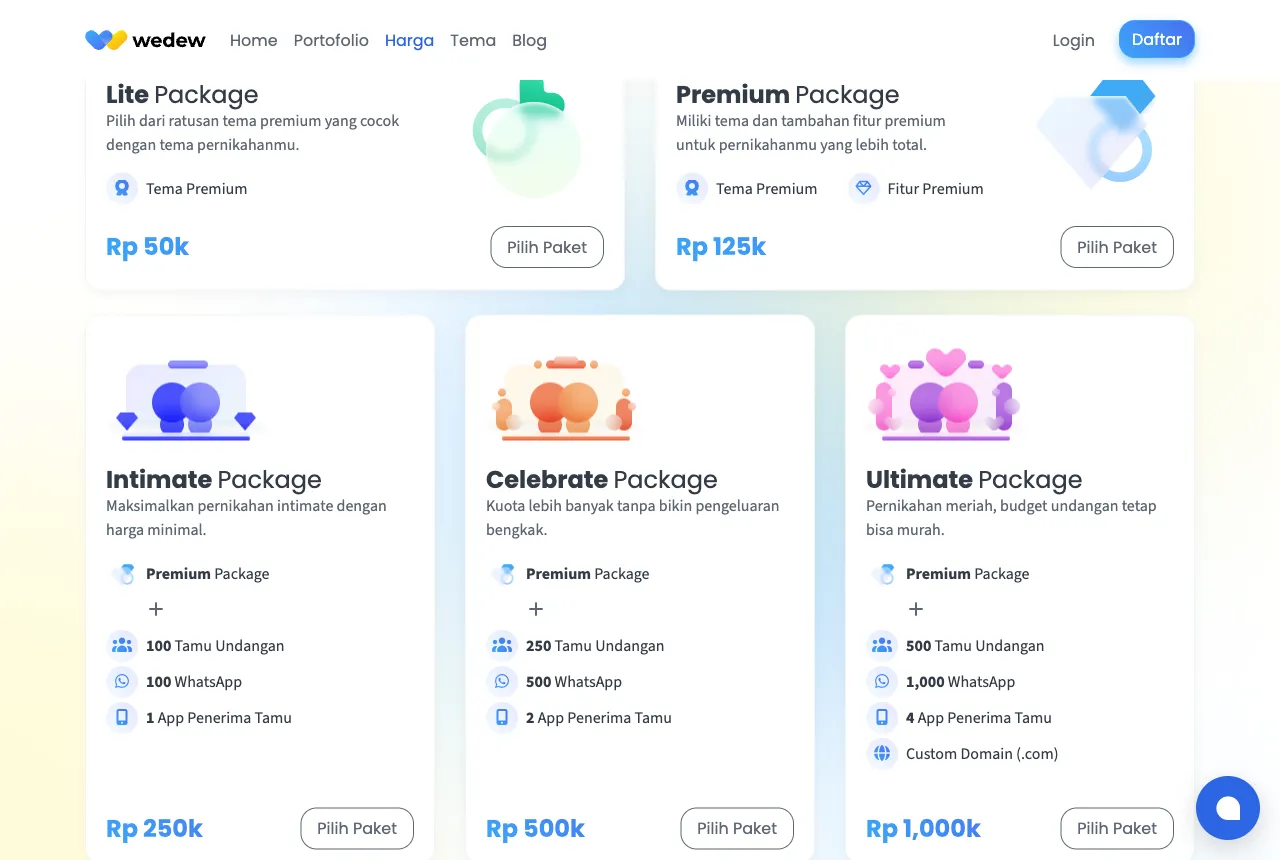
Wedew’s ladder. The first two rows are about themes; everything above them is about guest counts, WhatsApp allowances and reception apps.
Rp250,000 buys 100 guests, 100 WhatsApp messages and one guest-reception app. Rp500,000 buys 250 guests, 500 messages and two apps. Rp1,000,000 buys 500 guests, 1,000 messages, four apps and your own .com domain. The add-ons follow the same logic: 50 more guests for Rp25,000, 50 more messages for Rp40,000, one more reception app for Rp100,000.
The price doesn’t track how good the invitation looks. It tracks how many people have to be handled.
Invisay runs a different meter again. What separates its four packages isn’t only features but validity: two months, six months, one year. The Rp55,000 package dies two months after purchase. Walimatul does the same thing — six months for the cheap one, a year for the expensive one.
So the invitation isn’t bought. It’s rented, and the rent is charged per guest, per message sent, and per month it stays alive.
The two that stepped off the meter
Connectied has no pricing page at all. Its menu says Consultation.
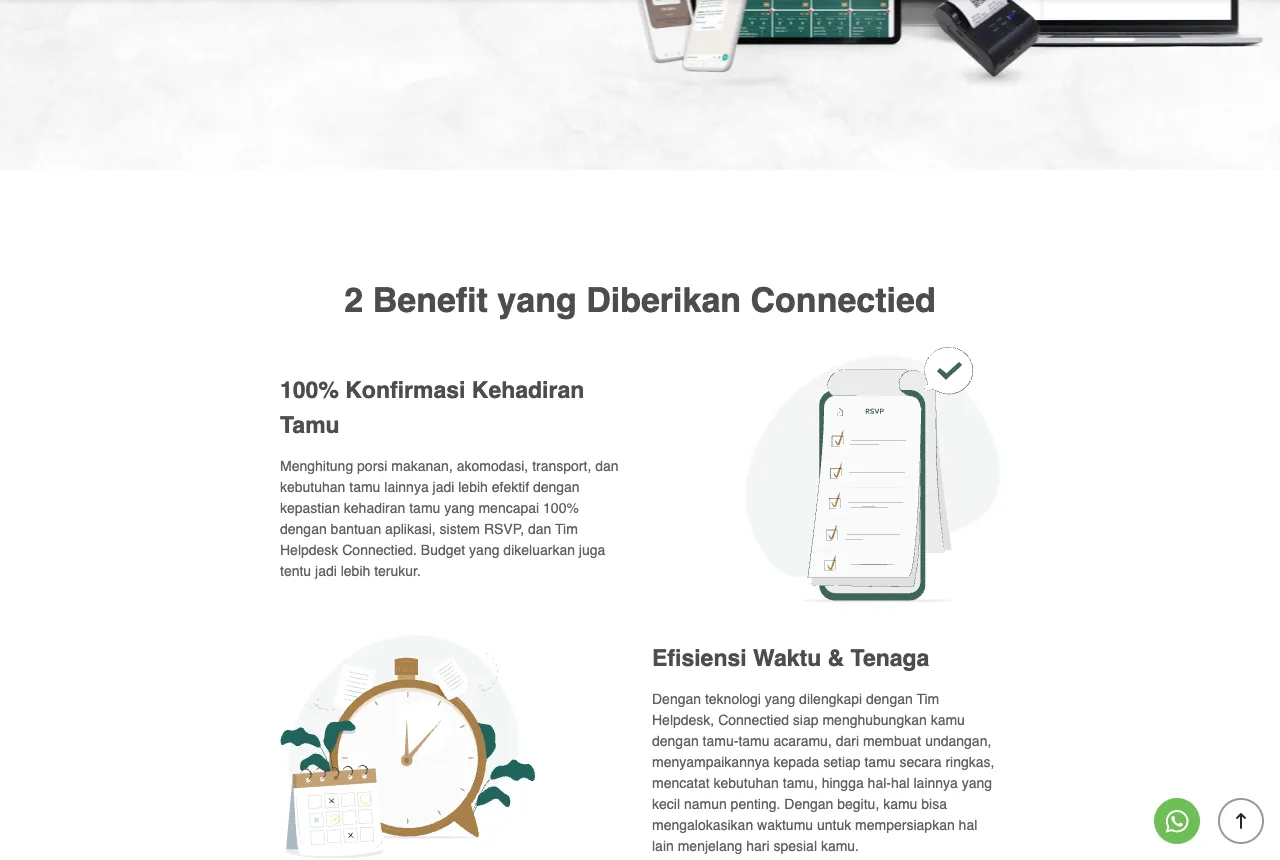
Connectied’s front page. No prices; an outcome instead.
What it promises isn’t an invitation but attendance confirmed to 100 percent, so that catering portions, accommodation and transport can be counted properly. The digital invitation is merely the route there. Behind it sit RSVP, multi-user access, reception packages and a helpdesk team — actual people who ring the guests one by one.
Once you’re selling an outcome, the price genuinely can’t go on a web page. The outcome depends on how many guests have to be chased.
Ajakan left through a different door: it doesn’t sell invitations to couples at all.
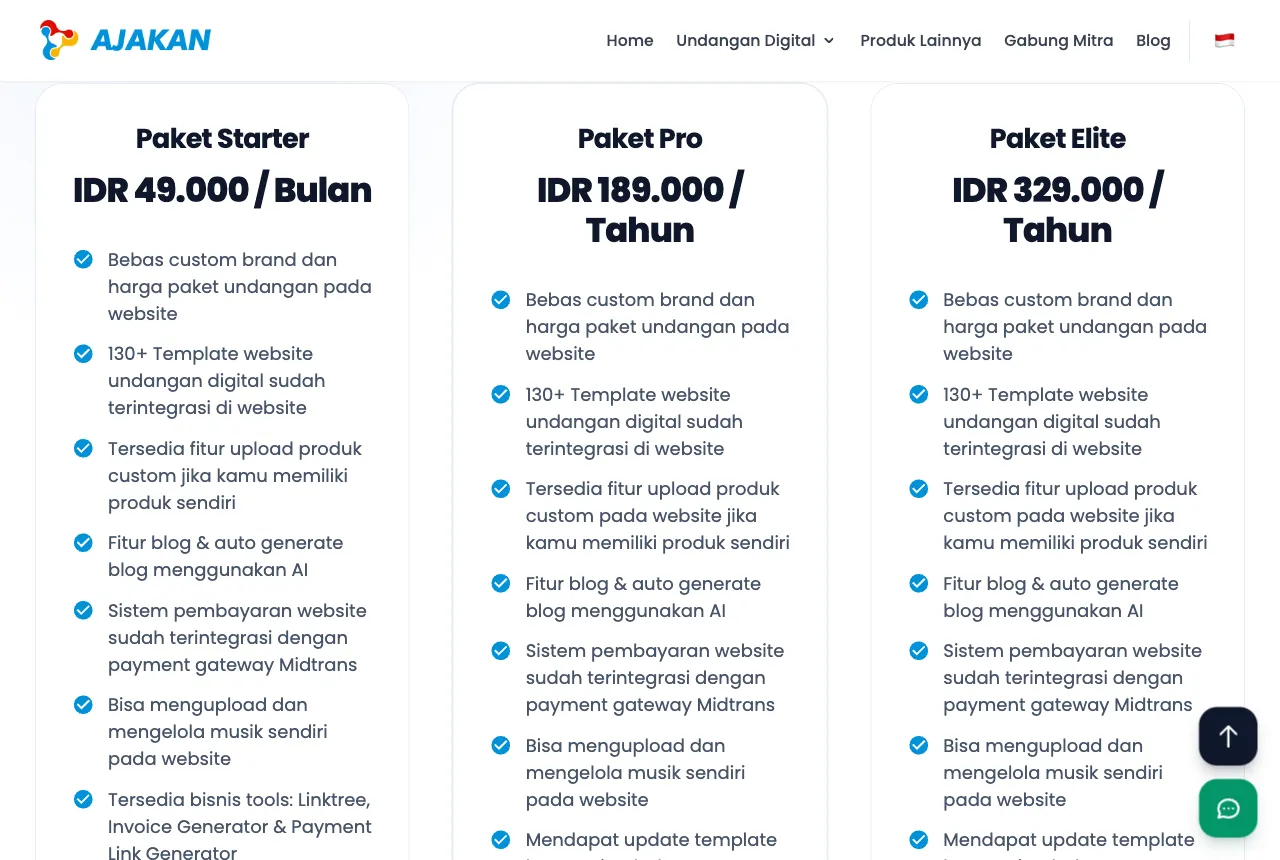
Ajakan sells the shop, not the invitation.
Rp49,000 a month buys a website under the partner’s own brand, 130-plus templates ready to sell, a payment gateway, WhatsApp blasts, a digital guest book, a dashboard and an invoice generator. Partners set their own retail prices. The front page carries a live counter: 493 partners, 75,558 orders.
And it isn’t only Ajakan. Walimatul and Invisay both run reseller pages of their own.
Which means anyone entering this business as a seller isn’t competing with six platforms. They’re competing with hundreds of people renting the same platform and selling the same templates with a different logo on top. That’s where the price pressure comes from.
There’s a quieter third route. On Wedew’s home page, among the claims of 40,000 events and 300,000 invitations, sits a figure of a different kind altogether: over Rp5 billion in cashless gift money has passed through them. That is money that moves at every wedding regardless of whether the couple paid for the invitation.
Why they all end up shaped like this
One thing makes this business unlike most apps: the customer buys once in their life.
You get married, you buy an invitation, you’re done. No monthly subscription, no repeat purchase next year, no reason to open the app again once the day has passed. And the cost of finding that customer still has to be paid: ads, content, wedding fairs, commission to the organiser.
If each customer can only be harvested once, all three shapes make sense on their own. The meter increases the yield from a single transaction. The reseller model swaps the customer for someone who does pay every month. And cashless gift money attaches itself to funds that were going to move anyway, rather than to a purchase decision.
Three answers to the same problem.
The gap that’s left
Competing on design looks pointless. They all have hundreds of templates, and Ajakan will sell those same templates to anyone with Rp49,000 a month.
Competing on price is harder still. Three of the six are free at the entry tier, and free is difficult to argue with.
The day itself isn’t as empty as it looks. Connectied is already sitting there, and so is the most expensive item on Wedew’s price list. But both sell it as a premium service with a human team behind it — expensive, and therefore worth doing only for large events.
What doesn’t exist yet is a cheap, self-service version of the same work. For a 200-guest reception in a rural district, which needs its catering numbers to be right just as much as a 2,000-guest one in the city, and which is never going to pay for a helpdesk team.
Which connects back to the question left hanging two weeks ago: all six of these are visibly built for the big cities. Most of those 1.48 million marriages a year don’t happen there.
A note
Every price above came off the companies’ own sites on 19 September 2026, and prices like these move easily.
The user figures are unaudited claims the companies make about themselves: Wedew cites 40,000 events and 300,000 invitations, Wevitation 2.5 million invitations shared, Walimatul over a thousand couples, Invisay over 999 couples a month, Ajakan 493 partners. I quote them because they’re what the companies put on their own pages, not because I can confirm any of them.